
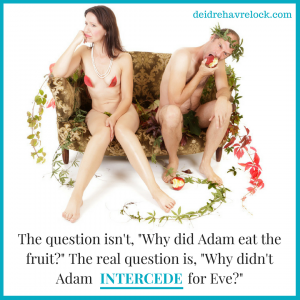
Why Didn’t Adam Intercede for Eve?

why did adam eat the apple?

Yes, Eve Was Tricked into Eating The Forbidden Fruit, But Have You Ever Wondered: Why Did Adam Eat?

I was sitting around one day, thinking about Adam and Eve (yes, this is the kind of thing I do) when the question struck me, “When Eve ate the fruit from the “Tree of Good and Evil” why didn’t Adam just jump in and intercede for her?”  Surely, that would have been the “loving” thing to do. Instead, Adam ate–why?

Of course, I had been taught through various churches and through Christian books I had read, that Adam ate the fruit after Eve because she persuaded him to do so. Adam erroneously followed Eve’s coaching because of his intense love for her.  In our imaginations we see Eve in the garden; she has just eaten the fruit and now she turns to her husband with a seductive smile and says something like, “Go ahead, you should eat this fruit. Do it for me.” To which Adam can only respond with fierce affection—he must obey Eve because of his love for her, as though his thinking went… “Well, if Eve’s going down this road of death then we’re both going down it together because I love her so much.” But take note: throughout the whole scenario with the serpent and the fruit, Eve says nothing to Adam. Eve does NOT speak to Adam. Adam eats, and no persuasion is needed.

Eve is the “Helper” who Received no Help

We hear time and time again, that Adam’s motivation was love for Eve. Adam’s fall was done out of a strange kind of love for woman–a very strange kind of love. A suicide fueled by love. Soooo romantic!

But I don’t buy it. Nope. Not at all. I call B.S.
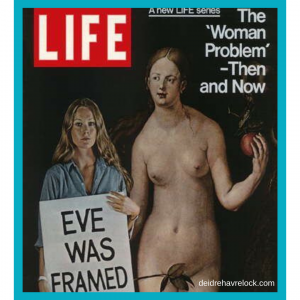
eve was framed

After all, when genuine love is involved, the first thing we do when a loved one falls into a trap set by an enemy is we rescue them; we plead for forgiveness and mercy on behalf of the one we love–we want to help them to become restored. What we don’t usually do is join them in their sin (unless we’re a little mixed up ourselves, perhaps waiting for the perfect opportunity to delve into the sin without drawing too much attention to our own sin — just sayin’).

And if we are deeply in love with someone (as Jesus is with humanity), we might even substitute ourselves with the person who committed the sin, saying “Let me take the consequence instead!” (As Jesus did for us). Interceding for humankind, that certainly is what Jesus did. He is our faithful intercessor. Jesus does not follow people into sin because he “loves” them. “Adam followed Eve into sin because of his intense love for her” sounds like a line because it is. It’s an explanation that is not sincere nor true.  Love rescues people. Love truly helps people. So when Adam didn’t step up for Eve, Jesus did. Jesus is the one who did not fail Eve. Jesus is the one working for Eve’s complete restoration.

The unfortunate truth about Adam’s fall is this (1) Eve did not convince Adam to eat the fruit. (2) Following Eve into sin provides Adam with a rather convenient scapegoat — the first to fall is seemingly to blame and accordingly sin can be attributed to them, leaving them feeling rather unfit and incompetent (especially if they were the one originally anointed to “help”; whereas the other person’s sin goes unaccounted for, hidden under layers of lies.  (3) Only two individuals leave the garden with any authority: Satan had authority over the world; and Adam now had authority over Eve.

So perhaps it’s time to crack open the book of Genesis again. And this time, instead of thinking how “in love” Adam was with Eve, ask yourself these all important questions, “When Eve fell, why didn’t Adam just simply intercede for her? What did Adam gain by eating the fruit?”

These questions, I believe, are key to understanding what really went down in Eden.

For more info on why Adam ate the fruit instead of interceding for Eve go to: Adam & Eve – 2 Different Types of Sin

Tags from the story
,
More from Deidre Havrelock

Hair is a Woman’s Glory — But Why?

Shares Facebook Twitter Pinterest Google+ Not too long ago (2014) I had...
Read More

11 Comments

  • I can’t agree more. I don’t think Adam loved Eve that much as we originally thought. First, where was he when the snake went to talk to Eve? He left her alone by herself. Second, he did not stop her from eating the fruit. Instead, he waited to see if she would die and when he saw she didn’t die, he wanted to eat it too. Third, he blamed her and God quickly without any hesitation. He loved himself above everyone else. That led me to believe that’s why more females are being saved than males. Although tremendous pain and difficulties are added to child birth for women, God sympathizes them so he saves their souls. But men are self centered. They lust after women and forsake God with the first given chance possible. Ultimately, God knows who’s sin was more severe!

  • I really like your comment about Adam not interceding for Eve. That is a big revelation to me. Some loving husband he was! And this was before sin even entered the world. No wonder the state of marriage is the way it is today- as well as the rate of domestic abuse! Eve’s daughters must become smarter so they don’t make the same mistakes she did.

  • Wow, these comments are totally off base, in Genesis 3, Adam never left EVE side he was right there, now i do agree that he should have said something why the serpent was talking to his wife, because he was there listening, but you have to keep in mind, they dont know what love is, they wasnt smart, thats the reason why there eyes were open after the ate from the tree and know they begin to gain knowledge, but eve ate, then after nothing happened to her, she turned and gave some to Adam, noticed i said turned, because he was there with her is what the word say, then they both now realize they were naked, but not before adam ate, now they are smart enough to hide for God. In the word God told Adam not to eat from this tree as a husband it was his job to tell eve and to protect her from the enemy talking to her, Also notice when God called out, he was calling adam, not eve, he wanted to talk to adam first because it was his responsibility to inform eve, then after adam told on eve, imagine a walking snake is what the serpent was, then God cursed him to crawl on his belly.

  • Just a couple thoughts…maybe off subject. First off…women need to b left alone. Eve didn’t cause the downfall. Clearly Satan started all the problems and I’m pretty sure he’s a HE. Lol. Secondly the bible clearly says through one MAN sin entered the earth. So it clearly stands to reason if Adam chose differently then things would not have gone down as they did. Perhaps God forgives Eve for him. Perhaps God destroys Eve and makes a new one. Lol. Perhaps Adam resists and both Satan and eve are destroyed. Who knows what God would’ve done? But it’s clear that because that one MAN screwed up….we are here now. Through one MAN sin entered the world. Thanks a lot Adam…u dick.

  • What if the serpent’s statement “you will not die” was a veiled threat on their lives? Adam had to have known what death was, and that it wasn’t pleasant. Could this have been done out of fear? I’m not excusing the actions, they should have trusted God.

  • Thank you all. I started looking deeper into this subject because I have non true believers in Kerrville, TX and they want to blame God for killing all the innocent people, including children in the Fourth of July, 2025 flood. So with another study the author reminded me about the troubles Job suffered. And then I began to wonder what would’ve happened if Adam had stopped Eve from eating the fruit and of course, wondering why he didn’t. All this brought me to your article and it really “opened my eyes”. Now I just have to figure out how to tell my family about free will and go from there and hope they are able to open their minds. You see, they are scientists so it’s going to be quite the challenge. They believe since they are educated they “know the truth”. It’s very sad to think I may never be able to reach them or many other people I meet.

  • I have to be blunt: this article oversimplifies Eve’s responsibility and misrepresents the narrative entirely.
    In Genesis 3, God told Adam:
    “You shall not eat of the tree of the knowledge of good and evil, for in the day that you eat of it you shall surely die.”
    The phrase “surely die,” “certainly die,” or “in the day you eat” naturally implies immediate death. No delayed time- frame is given, nor explanation of spiritual or deferred death. Adam had no empirical way to verify the command, and any waiting, observation, or reflection on progressive outcomes would contradict God’s absolute certainty. He is placed in a cognitive bind from the start. While some might argue he could have waited until the day ended or consulted God before acting, the immediate survival of Eve and his own knowledge of the command reinforced uncertainty and challenged his beliefs, making the epistemic conditions highly ambiguous.
    Adam had previously communicated God’s warning to Eve, yet she acted alone (the text specifies that the serpent spoke to Eve, not both or no evidence of him listening the conversation), deliberately undermining him and trusting the serpent’s promise. Importantly, this was entirely a verbal exchange, fully accounted for in the text. There is no evidence of hidden influence or secret persuasion beyond the spoken communication between the serpent and Eve. Adam’s decision is based solely on observing her actions and the knowledge of what he had been told by God.
    She ate, survived, and gained knowledge. When she turned and presented the fruit to Adam,we can argue simply witnessing her alive directly contradicted the command as he understood it, leaving him psychologically almost forced to act the same way. Conflicting evidence and his incomplete information (delayed spiritual death, eventual eviction, etc.) made his choice almost inevitable. While this can be regarded as sin, it reflects human cognition under uncertainty, not moral weakness or arbitrary failure. He could have sought further guidance from God before acting, but the fact she had not died would naturally reinforce doubt unless he possessed divine insight beyond human capacity, something no human has.
    Critically, Eve’s unilateral action created the epistemic conditions that made Adam’s choice almost inevitable. This is human cognition under uncertainty, not moral failure.
    Moreover, blaming Adam for Eve’s conscious decision as this article does after she deliberately undermined his warning and defied the truth he communicated can itself be psychoanalyzed and shown to foster hate, just as the author twists Eve’s role to promote ideology. This perfectly illustrates the lack of accountability some women enjoy: blaming men while taking no responsibility for their own actions. It also demonstrates how they benefit from consistent, undeserved love, attention, and admiration, misapplied in ways that distort reasoning while remaining infatuated with themselves. The author’s disgust, framed as “out of love,” is deeply ironic:
    It can be argued, Eve betrayed trust, did not consult Adam before acting, and placed the serpent’s words above her partner’s as “helper,” yet the author portrays her actions as benevolent. She also downplays the role of the temptation itself, the fruit being pleasant to the eye and offering knowledge, which actively contributed to the situation. The article further indulges in speculation, claiming, “…unless we’re a little mixed up ourselves, perhaps waiting for the perfect opportunity to delve into the sin without drawing too much attention to our own sin just saying.” This is excessively speculative, projecting a hypothetical internal working onto Adam(figuratively Men). The biblical text does not provide, and it reveals the depraved mentality of the author(“just sayin”). The Bible also provides no account of Adam’s internal deliberations in the way it describes Eve’s reasoning, seeing the fruit as “good for food,” “pleasing to the eye,” and “desirable for gaining wisdom.” By ignoring this distinction, the author fails to question what governed Eve’s choice, her responsibility, and her susceptibility to temptation, instead imposing a narrative that obscures her conscious agency and misrepresents Adam’s adherence to God’s command prior to her action. Society often grants undeserved love, admiration, glorification, and attention to women, which in turn can reinforce self-infatuation, perpetuating cycles of misapplied responsibility and distorted moral reasoning.
    Finally, the article and its author (Deidre Havrelock) must be called out: this is extremism masquerading as insight, a work of self-serving propaganda. By placing all blame on Adam and twisting facts to fit an extreme feminist narrative, the author demonstrates a total lack of rational judgment, responsibility, or understanding of human behavior, effectively promoting hate disguised as scholarship. This is socially dangerous, intellectually dishonest, and in any society that values reason and justice, such extremism should be held accountable because it spreads misinformation, fuels resentment, and models irresponsibility.
    I am in no doubt that you (Deidre Havrelock) have excelled in life and remain entirely unchecked in your attitudes, proudly standing with your chest up in what can only be described as hate (which, I would argue, looking down on men describes even better). While feminism in its earlier days was undeniably necessary, in modern society it has largely run its course. Today, it would make far more sense to apply it only in remote areas or extremely religious contexts. ironically, the very places the author seems to be trying to justify with her narrative, where feminism often has no place. Its rightful focus now should be solely on ensuring basic human rights, equal for all, rather than dictating who is responsible for whom in a civilized society. From your article, it is evident that you have not taken responsibility for any of your own actions or beliefs, yet feel free to assign blame to others.
    Free thinking and expression are essential for learning and must allow criticism. But make no mistake: the author is promoting a harmful, ideologically driven narrative, and in any capacity of intelligence or moral awareness, it is undeniably evil.

    • Adam’s failure can be a failure of faith.

      It is about which interpretation makes the fewest assumptions and best explains the situation.

      But it is far better than saying he manipulated Eve, should have stopped her, was listening, gave confirmation to her eating the fruit, or did it because he loves her, none of these are written or suggested in the text, and framing it this way seems unfair and overly assumptive.

      This makes sense to me, because the perception was that they would die if they ate, as Eve told the serpent. Hence my explanation.

      I also want to acknowledge that I spoke personally and strongly earlier. However, I still strongly disagree with interpretations like this. Promoting women’s equality should be based on deserving attributes, not on hating or discriminating against men. Thank you, God bless you.

  • Adam’s failure can be a failure of faith.

    It is about which interpretation makes the fewest assumptions and best explains the situation.

    But it is far better than saying he manipulated Eve, should have stopped her, was listening, gave confirmation to her eating the fruit, or did it because he loves her, none of these are written or suggested in the text, and framing it this way seems unfair and overly assumptive.

    This makes sense to me, because the perception was that they would die if they ate, as Eve told the serpent at that moment. Hence my explanation.

    I also want to acknowledge that I spoke personally and strongly earlier. However, I still strongly disagree with interpretations like this. Promoting women’s equality should be based on deserving attributes, not on hating or discriminating against men. Thank you, God bless you.

  • Adam’s failure can be a failure of faith.

    It is about which interpretation makes the fewest assumptions and best explains the situation.

    But it is far better than saying he manipulated Eve, should have stopped her, was listening, gave confirmation to her eating the fruit, or did it because he loves her, none of these are written or suggested in the text, and framing it this way seems unfair and overly assumptive.

    This makes sense to me, because the perception was that they would die if they ate, as Eve told the serpent. Hence my explanation.

    I also want to acknowledge that I spoke personally and strongly earlier. However, I still strongly disagree with interpretations like this. Promoting women’s equality should be based on deserving attributes, not on hating or discriminating against men. Thank you, God bless you.

  • Adam’s failure can be a failure of faith.

    It is about which interpretation makes the fewest assumptions and best explains the situation.

    But it is far better than saying he manipulated Eve, should have stopped her, was listening, gave confirmation to her eating the fruit, or did it because he loves her etc.. none of these are written or suggested in the text, and framing it this way seems unfair and overly assumptive.

    This makes sense to me, because the perception was that they would die if they ate, as Eve told the serpent. Hence my explanation.

    I also want to acknowledge that I spoke personally and strongly earlier. However, I still strongly disagree with interpretations like this. Promoting women’s equality should be based on deserving attributes, not on hating or discriminating against men. Thank you, God bless you.

Leave a Reply

Your email address will not be published. Required fields are marked *

This site uses Akismet to reduce spam. Learn how your comment data is processed.